
IP Consulting
    /
    Examples and public work

    See what the work produces

    Explore three kinds of work: reviewing published SFCRs, documenting and testing model behaviour, and building a recurring reporting process. Each example shows the outputs, their sources and the scope of the evidence.

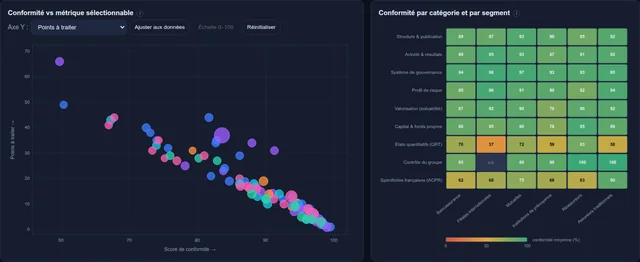
    SFCR dashboard showing the distribution of study scores and scores by insurer segment.

    Study scores · Disclosure completeness

    Mean
    87.7%
    Median
    89.9%
    Study findings and sources

    01 · SFCR review

    From published reports to findings you can trace.

    Trace an assessment from insurer scores to published disclosures.

    Inspect sourced findings, disclosure gaps and questions for actuarial judgement.

    Observed public study · 86 reports · 158 controls · 11,465 assessments

    Explore the SFCR studyStudy scope and methodology
    One calculation inside a model

    Public synthetic workbook · Recorded evidence

    V2 applies the rate at initialisation. Later steps subtract outgo without another growth term.

    V2 · Base scenario · Period 1

    Source · LibreOffice
    49,741.55
    Python replica
    49,741.55

    Within recorded tolerance

    Relative tolerance: 1e-9

    Model monetary units · Rounded to two decimals

    This comparison covers one component. Interfaces and complete-model outputs need their own checks.
    Exact values and sources

    Reference engine: LibreOffice 24.2.7.2; compared with the Python replica. Recorded results. The source engine and replica were not rerun for this website. Rounded agreement does not mean exact equality.

    Record
    Projection!FUND_V2 · base · index 1
    Source value
    49741.5512475391
    Replica value
    49741.55124753906
    Recorded delta
    -4.3655745685100555e-11
    Recorded verdict
    pass
    Projection!M3
    =(M2-$T3-$U3-$V3)
    Recorded run
    2026-07-10T07-34-16_generic_life_model_inventory_537c64
    Pinned revision
    fa9fad20178ce8b4f9a19db7b2879d8159e1fb2b

    02 · Model understanding & migration

    Understand your model. Prepare its next version.

    See how connected calculations explain results and reveal what a change may affect, across model configurations.

    Explore source-linked rules and tests that support maintenance and migration, with outputs checked against the original.

    Illustrated whole-model method · Two recorded evidence dossiers

    Explore the whole-model methodInspect the calculation and its checks
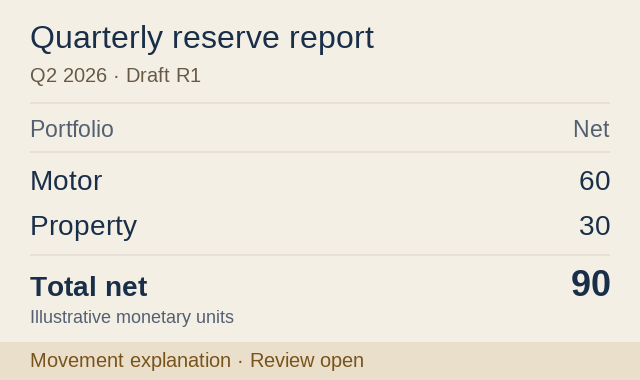
    Synthetic quarterly reserve report: motor net reserves 60, property 30, total 90 illustrative monetary units; draft with a movement explanation awaiting review.

    03 · Recurring reporting

    Build a repeatable process for actuarial reporting.

    Trace a figure, follow a review challenge and replace a source to see why fresh approval is required.

    Keep templates and source mappings for the next cycle; retain each report revision and its decisions.

    Illustrative workflow · Synthetic data · Simulated decisions

    Explore the reporting workflow
    More public work

    Production automation in practice

    Actuary in a Box shows calculation execution, diagnostics, sensitivity analysis and a pack for human review.

    Recorded demonstration·Actuarial production

    Actuary in a Box

    Follow a Mack reserving workflow from calculation to review pack: a diagnostic warning triggers a sensitivity, and both remain visible for review.

    Mack reserving workflow · Silent screen recording

    How to read the examples

    The scope matters as much as the result

    Inspect the sources

    Public code, evidence and report references let you follow the basis for a finding.

    Read the boundaries

    Scenarios, tolerances and control sets describe what was tested. Simulated results are labelled at the point of use.

    Keep judgement visible

    A test result informs a review. The actuary interprets the finding and decides what action to take.

    Does one example resemble a problem in your team?

    Describe your existing process and the change you need. Before implementation, agree source access, scope, outputs, responsibilities and acceptance criteria.